

Paying an entire commercial insurance premium in one lump sum strains even a healthy balance sheet. For many business owners, a large annual payment ties up cash that could be put to work elsewhere. That is where insurance premium financing comes in. It gives you a way to keep your coverage in force while spreading the cost into manageable payments.
But like any financial tool, it has trade-offs worth understanding before you sign. In this guide, you’ll learn exactly how insurance financing works. That includes the real advantages it offers and the disadvantages to watch for, as well as how to decide whether insurance loan services make sense for your situation.
Keep reading to learn more.

What is insurance premium financing?
Insurance premium financing is a lending arrangement that lets you borrow the cost of an insurance premium and repay it over time. Instead of paying your carrier the full amount at once, a premium finance company pays the premium on your behalf. You then repay the lender in scheduled installments, typically after making a down payment.
The insurance policy itself usually serves as collateral for the loan, which keeps the process straightforward and approval fast. Importantly, financing is optional and does not change the price of your coverage. Indeed, the policy’s cost stays the same whether you pay upfront or finance it. What changes is how and when you pay.
This approach is most common in commercial insurance, where premiums can reach tens or hundreds of thousands of dollars across commercial auto, umbrella, and other coverages.
A well-structured premium finance agreement should read clearly. You should be able to easily see repayment schedules, interest rates, and fees spelled out before you sign. Transparency is the hallmark of a trustworthy insurance loan provider.
How insurance premium financing works
The mechanics of insurance financing are simple once you see them laid out:
- You arrange coverage. You select your insurance policy through your agency, as you normally would.
- A finance agreement is generated. Your agency creates a premium finance agreement using the lender’s platform.
- You make a down payment. Most agreements require a down payment, commonly 10% to 25% of the total premium.
- The lender funds your premium. The premium finance company pays your carrier the full premium directly.
- You repay in installments. You repay the lender in affordable monthly payments, usually over 10 months.
Because the policy backs the loan, approval is usually quick (often within a day or two), and lenders focus more on the quality of the underlying policy and carrier than on your business credit score.
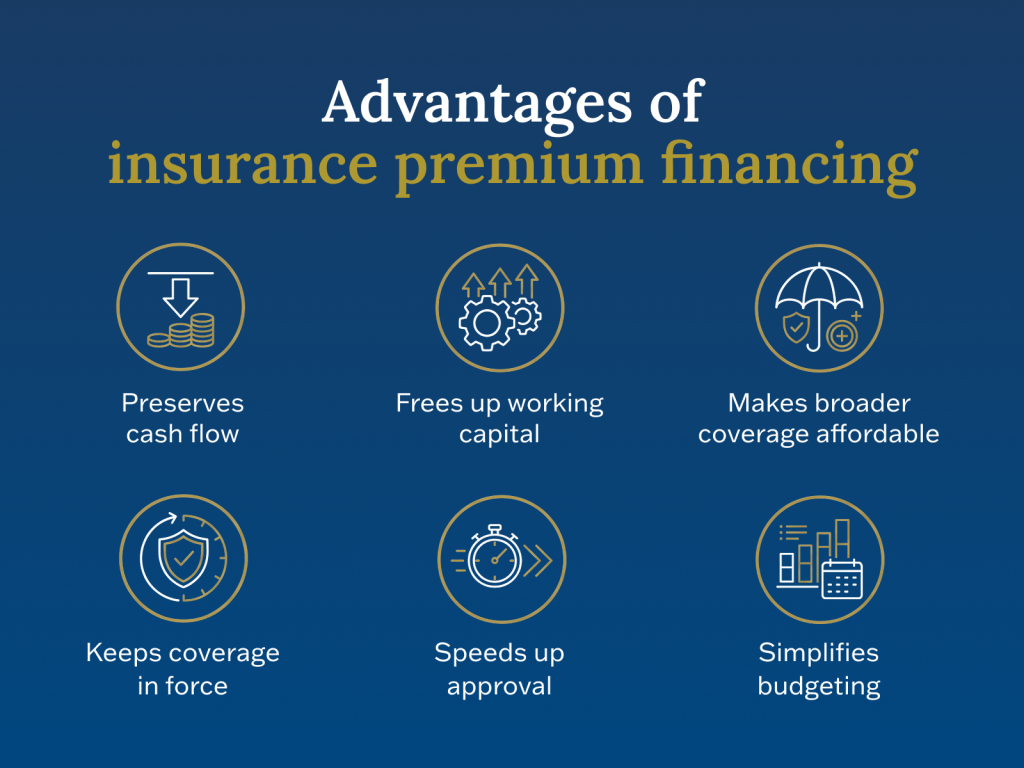
Advantages of insurance premium financing
Premium financing offers several clear benefits, especially for businesses managing tight or seasonal cash flow.
- Preserves cash flow: Instead of a single large payment, you keep more cash on hand for daily operations and expenses like payroll.
- Frees up working capital: The money you would have spent upfront can be reinvested in your business, where it may generate a stronger return than the financing cost.
- Makes broader coverage affordable: Spreading payments puts higher limits or additional policies within reach that a lump sum might have ruled out.
- Keeps coverage in force: By making premiums manageable, financing helps ensure you don’t skip or underinsure critical coverage to save cash.
- Speeds up approval: Because the policy serves as collateral, insurance loan services typically approve applications quickly and with less credit scrutiny.
- Simplifies budgeting: Predictable monthly installments make it easier to forecast expenses and manage your books throughout the year.
For agencies, offering financing also helps clients afford coverage and close more policies, a win that strengthens the agent relationship while giving business owners flexibility.
Disadvantages of insurance premium financing
No financial tool is without trade-offs, and it pays to go in with clear eyes.
- Interest adds to the total cost. You will pay more over the life of the loan than you would if you paid the premium in full.
- Rates fluctuate. Some financing arrangements tie interest to a benchmark rate, so your cost may shift with market conditions rather than staying fixed.
- Missed payments cancel your policy. Because the policy is collateral, falling behind on installments triggers cancellation, leaving you exposed at the worst possible moment.
- Fees vary between providers. Origination charges, service fees, and processing costs vary by lender, and unclear terms erode the benefit.
- It adds a layer of obligation. Financing introduces another agreement for management and monitoring, in addition to your coverage.
- The math doesn’t always favor it. If the capital you free up doesn’t cover the financing costs, paying upfront may be the better move.
The key is to compare the total financing cost with the value of the cash you keep working in your business.
Common mistakes to avoid
When you use insurance financing, steer clear of these missteps:
- Skipping the fine print. Always confirm the individual fees and cancellation terms before signing.
- Choosing a lender on price alone. Service quality and clear communication matter when questions arise.
- Ignoring the total cost. Look beyond the monthly payment to the full amount you will repay.
- Missing installment deadlines. Set reminders or automate payments to avoid triggering a cancellation.
- Financing when you don’t need to. If you have ample cash and no better use for it, paying up front may cost less in the long run.
- Overlooking pre-cancellation support. Reputable providers offer advance notice — such as 10-day, five-day, and three-day pre-cancellation calls — that help you stay on track.
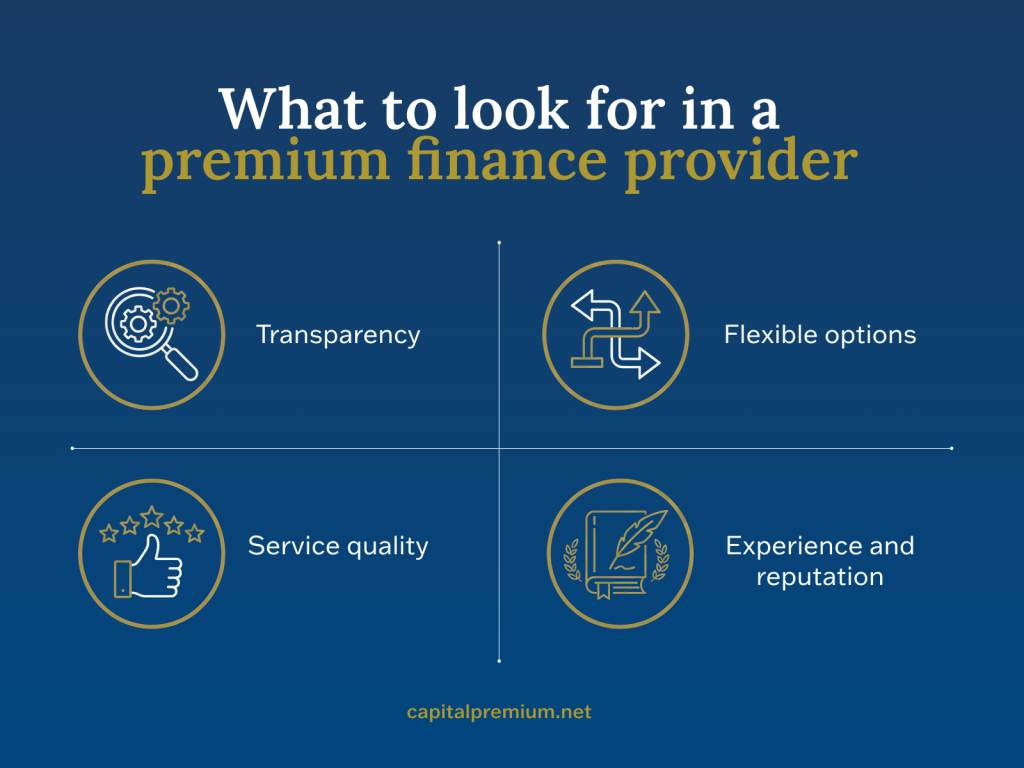
What to look for in a premium finance provider
Not all insurance loan services are the same, so choosing the right partner matters as much as the decision to finance.
Start with transparency: a trustworthy provider clearly outlines everything before you sign, without confusing language or hidden costs. Look for flexible options that fit your cash flow rather than a one-size-fits-all structure, since every business has different needs.
Service quality is equally important. When a question comes up or a payment date approaches, you want a responsive team and clear communication. Reliable providers also offer advance notice before cancellation, so a missed installment doesn’t quietly cost you coverage.
Finally, consider experience and reputation. A provider with a long track record and strong agency relationships is more likely to deliver the consistency and support your business depends on, especially when circumstances change or questions arise mid-term.
Data and statistics
The global premium finance market was valued at USD 49.5 billion in 2024 and is projected to grow at a 10.7% compound annual rate through 2034, driven largely by rising premium costs.
How to decide if it’s right for you
Premium financing makes the most sense when preserving cash matters more than the interest your business will pay. Ask yourself a few questions:
- Would a lump-sum payment strain your operations or reserves?
- Could the freed-up capital earn more than the financing costs?
- Do you value predictable monthly payments over a single large outlay?
- Is your premium large enough that spreading it delivers meaningful relief?
If you answered yes to most of these, financing is worth exploring. If you have surplus cash and no higher-value use for it, paying upfront may serve you better. The right choice depends on your cash flow and goals, as well as the terms your provider offers.
For insurance agents: how premium financing helps your clients
As the agent, you sit between your client and their coverage, and premium financing is one of the most practical ways to serve them well. When a client faces a large annual premium, financing lets you offer a solution that keeps their business protected rather than forcing a hard choice between cost and coverage.
For your clients, the advantages are real.
Financing preserves their cash flow, so they keep working capital available for business expenses instead of tying it up in a single large payment. It also means they don’t have to trim coverage or accept lower limits to make the premium affordable.
They get the protection their business actually needs. And with predictable monthly installments, budgeting becomes easier and more stable throughout the year.
When you introduce financing, you’re helping clients avoid the trap of underinsuring to save cash, a decision that leaves them dangerously exposed. By spreading the cost, you make full, appropriate coverage attainable, which protects their business at the moments that matter most.
The agents who best serve clients raise financing early, especially for businesses facing rising premiums or seasonal revenue.
Frequently asked questions about insurance premium financing
Q: How does insurance premium financing affect the cost of my policy?
It doesn’t change your premium. The cost of your coverage stays the same whether you finance or pay in full. Financing adds interest and any applicable fees, but the underlying policy price is unchanged.
Q: What happens if I miss a payment?
Because your policy serves as collateral, missed payments lead to cancellation. Most reputable lenders provide advance pre-cancellation notice, giving you a chance to
Q: What types of insurance can be financed?
Premium financing applies to most commercial policies, including commercial auto, general liability, property, umbrella, and package policies. Many specialty lenders also finance bonds, audits, flood, aviation, and marine insurance, as well as coverage from non-rated carriers or risk retention groups.
Q: Does financing require a credit check?
Usually, the review is light. Because your policy serves as collateral, lenders focus on the quality of the coverage and carrier rather than your business credit score, which is why approval is often fast and accessible to more businesses.
Q: What happens to my financing if I cancel my policy mid-term?
If you cancel, the carrier returns the unearned premium to your finance company, which applies it to your outstanding balance. Any remaining credit is refunded to you, and any shortfall is still your responsibility to repay.
Q: Who arranges the premium financing? Me or my agent?
Typically, your agent or agency sets it up. They generate the finance agreement through the lender’s platform. You review and sign it and make your down payment. Finally, you repay the lender directly in monthly installments.
Talk to Capital Premium Financing today
Premium financing turns a large, one-time premium into manageable payments, preserving cash flow and keeping your coverage secure. The advantages of stronger liquidity and broader coverage are real, but so are the trade-offs of added interest and the need to stay current on payments. Understanding both sides puts you in control of the decision.
If you’re ready to explore a financing solution built around your business, contact Capital Premium Financing to talk with a specialist or request a consultation.


